
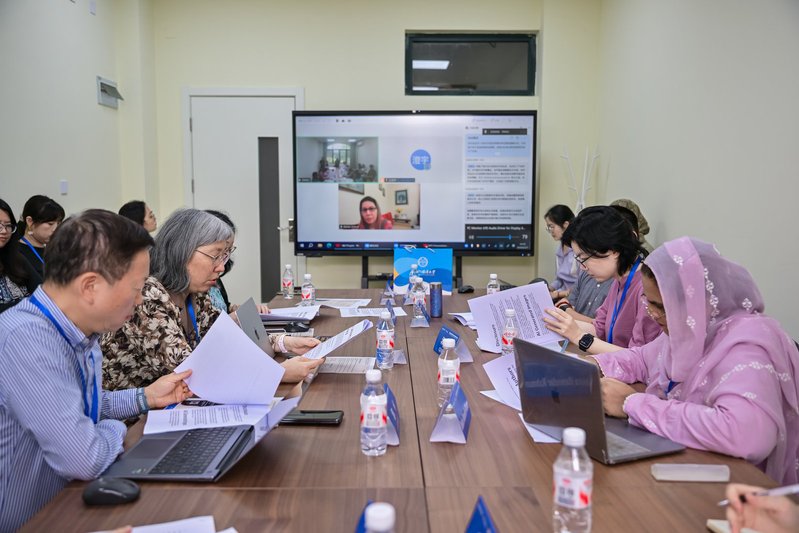
On June 27, OMGC celebrated its 5th anniversary at the 9th Annual Conference on Image Studies and Global Communication, hosted by Shanghai International Studies University. As part of the anniversary program, OMGC organized a roundtable titled “Publishing Ethics in the Age of AI: Challenges and Issues.” The event brought together nine communication scholars who also serve as editors of international journals to share their perspectives on emerging challenges and ethical considerations in academic publishing. The following summarizes the key insights shared by the participants:
I. Current Landscape and Differences in AI Policies Across Scholarly Journals
Recognizing the varying circumstances of different countries and publishing organizations, the meeting examined the current governance frameworks for AI and the practical challenges associated with their implementation.
1. Policy Orientation and Practices of International Journals
An open and inclusive stance. OMGC follows the policies established by their publisher. While authors are not prohibited from using AI as a research and writing aid, AI may not be listed as an author, and manuscripts whose substantive content is generated by AI are not accepted.
Strict restrictions and mandatory disclosure. The policy explicitly prohibits the use of generative AI to create or manipulate images. In addition, the use of any AI tool must be fully disclosed to ensure transparency and traceability throughout the publication process.
Regulatory compliance and regional adaptation. Because the journal is published in Germany, it must comply with the European Union's AI Act and the General Data Protection Regulation (GDPR). At the same time, editorial policies must accommodate differences in AI regulations across jurisdictions worldwide.
2. Preliminary Developments in Pakistan's Higher Education System
Delayed policy development. Abida Ashraf noted that Pakistan currently lacks a unified AI policy for scholarly journals. The Higher Education Commission (HEC) is drafting a national framework, which remains in the proposal stage.
Current practice based on similarity thresholds. In the absence of formal AI-specific policies, journals generally continue to use an 18% similarity threshold for plagiarism screening, without distinguishing AI-generated content from other forms of text overlap.
II. Challenges in Detecting AI-Assisted Writing and Maintaining Academic Integrity
Participants engaged in an in-depth discussion of the limitations of current technologies for identifying AI-generated content and the resulting challenges for scholarly evaluation.
1. The Concealment of AI-Generated Content and the Failure of Existing Detection Methods
Technological gaps create regulatory blind spots. Abida Ashraf observed that students increasingly use tools such as Humanata to 'humanize' AI-generated text, making it difficult for conventional plagiarism-detection software such as Turnitin to identify AI-generated writing accurately. As a result, editors face growing challenges in distinguishing authentic human writing from AI-assisted content.
The 'reverse logic' paradox of language quality. For students whose first language is not English, assignments written in flawless, near-native English may themselves constitute indirect evidence of AI assistance, because such language quality may be inconsistent with the student's demonstrated level of proficiency.
2. Fabricated References and the Challenge of Fact Verification
The proliferation of fabricated citations. Large language models (LLMs) frequently generate nonexistent or inaccurate references. Existing AI-detection tools are generally unable to verify the authenticity of citations, posing a significant threat to academic rigor.
The increasing burden on peer reviewers. Because AI systems may fabricate facts, data, and references, reviewers would need to devote substantially more effort to verifying citations, often checking each reference individually to confirm its authenticity.
III. Redefining the Nature of Scholarship in the AI Era: Strategic Recommendations
In response to the transformative impact of AI, participants called for a redefinition of scholarship and proposed a more forward-looking framework for AI governance.
1. From 'Prohibition' to 'Collaboration': A Paradigm Shift
Integrating instrumental rationality with human-centered scholarship. AI should not be regarded solely as a threat but rather as an 'assistant' that can help researchers organize ideas, improve writing, and enhance productivity, while the generation of original ideas and intellectual contributions must remain firmly under human control.
Reframing academic value. Genuine scholarly contribution lies in creating new knowledge rather than merely compiling existing information. Even when AI is used, research should ultimately address real-world problems and generate meaningful value for society.
2. Establishing an Evolving, Tiered Governance Framework
A traffic-light classification system. Drawing on the practices of publishers such as Sage and DGB, participants proposed classifying AI use into three categories: assistive use (e.g., grammar and language editing, with no disclosure required), acceptable research use requiring disclosure (e.g., AI-generated charts and figures based on real research data, coding) and prohibited use.
An adaptive policy framework. Given the rapid pace of AI development, governance policies should remain flexible and be reviewed annually or semiannually, allowing specific provisions to be updated as AI technologies and their applications continue to evolve.
***
Roundtable Participants:
Louisa Ha, OMGC Founding Editor-in-Chief; University Distinguished Research Professor, Bowling Green State University, USA
GUO Ke, OMGC Co-Editor-in-Chief; Professor, Shanghai International Studies University, China
CHEN Peiqin, OMGC Co-Editor-in-Chief; Professor, Shanghai International Studies University, China
PAN Ji, OMGC Associate Editor; Professor, Fudan University, China
Abida Ashraf, Editor, Journal of Media & Culture Studies; Dean of the Institute of Communication Studies, University of the Punjab, Pakistan
Bushra Hameedur Rahman, OMGC Editorial Board Member; Dean of Faculty of Media and Mass Communication, Beaconhouse National University, Pakistan
LI Zhi, OMGC Editorial Board Member; Professor of the School of Television, Communication University of China.
GUO Lei, Associate Editor, Communication and Change; Professor of the School of Journalism, Fudan University, China
LI Siyue, Associate Editor, Communication and the Public; Vice Dean of the College of Media and International Culture, Zhejiang University, China
LI Xiaomeng, OMGC Managing Editor, Assistant Research Fellow, Center for Global Public Opinion of China, Shanghai International Studies University, China